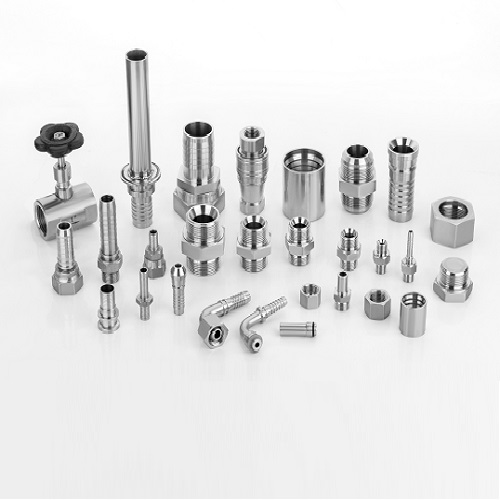
Hydraulic hose fittings are essential components used to connect hydraulic hoses to other parts of a hydraulic system, such as pumps, valves, cylinders, and other equipment. These fittings create secure, leak-proof connections that ensure the efficient transfer of hydraulic fluid under high pressure.
Purpose: To securely connect hydraulic hoses to equipment, ensuring fluid is transferred efficiently without leaks or loss of pressure.
Types of Hydraulic Hose Fittings:
Male and Female Fittings: The male fitting has external threads, while the female fitting has internal threads, allowing them to connect securely.
Elbow Fittings: These allow fluid to change direction, typically at a 45° or 90° angle, ideal for navigating tight spaces.
Straight Fittings: Used to connect hoses directly without any changes in direction.
Tee and Y Fittings: Used for branching fluid flow into multiple directions.
Reducer Fittings: These fittings connect hoses of different sizes, allowing for a change in diameter between components.
Materials: Hydraulic hose fittings are typically made from:
Steel: For general use in high-pressure applications.
Stainless Steel: Used in corrosive environments or high-temperature applications.
Brass: Common for low-pressure systems.
Aluminum: Lightweight and corrosion-resistant, suitable for some hydraulic applications.
Thread Types:
NPT (National Pipe Thread): A tapered thread, commonly used in North America.
BSP (British Standard Pipe): Often used in Europe and other international markets.
JIC (Joint Industrial Council): A standard for 37° flare fittings used in many hydraulic systems.
Applications: Hydraulic hose fittings are used in various industries, including:
Construction: For equipment like excavators, bulldozers, and backhoes.
Agriculture: In machinery like tractors and harvesters.
Automotive: For hydraulic braking systems, power steering, etc.
Manufacturing: Connecting machinery, presses, and lifts.
Leak-Proof Connections: Properly installed hydraulic hose fittings prevent leaks, ensuring system efficiency and safety.
High Pressure and Temperature Resistance: Hydraulic hose fittings are designed to withstand high-pressure fluids, making them ideal for demanding industrial environments.
Durability: Made from strong materials like steel or stainless steel, they are durable and long-lasting, even in harsh operating conditions.
Hydraulic hose fittings are crucial for the proper functioning of hydraulic systems, providing secure, reliable connections that ensure fluid flows efficiently and safely. They come in various types, sizes, and materials to meet the specific requirements of different industries and applications.